1. Background and Historical Context
The Kew Gardens 50p was released by the Royal Mint in 2009 to commemorate the 250th anniversary of the Royal Botanic Gardens at Kew. Kew, located in Richmond-upon-Thames in London, began life in the mid-eighteenth century as a royal estate where exotic plants were cultivated and studied. Over time, the gardens developed into a world-leading centre for botanical research, conservation and education.
By 2009, Kew Gardens had become both a scientific powerhouse and a major visitor attraction, recognised as a UNESCO World Heritage Site. Marking the 250-year milestone on circulating coinage provided a way to celebrate this dual role: a scientific institution safeguarding plant biodiversity, and a public garden enjoyed by millions of visitors each year.
The choice of the fifty pence denomination was deliberate. Since its introduction in 1969, the 50p has been used to celebrate a wide range of national events, institutions and cultural milestones. Commemorating Kew on a 50p placed the gardens firmly alongside other major themes such as the NHS, the Olympic Games and literary anniversaries.
2. Design and Symbolism
2.1 Reverse Design – The Pagoda and Vine
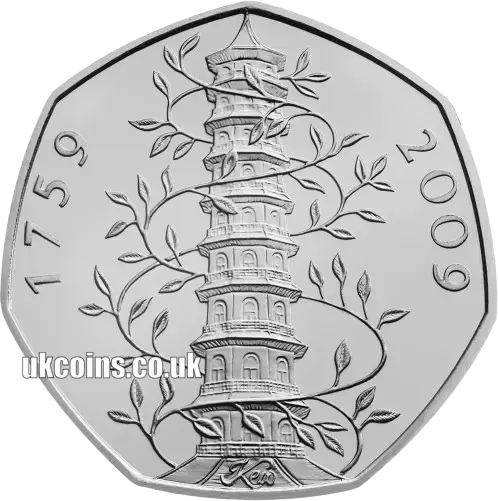
The reverse of the Kew Gardens 50p was created by British artist Christopher Le Brun RA. The central feature is the striking Chinese Pagoda that stands within the gardens. Completed in 1762, the pagoda is one of Kew’s most recognisable structures and an instantly identifiable silhouette on the London skyline.
On the coin, the pagoda is shown rising vertically through the centre of the design, framed by a decorative climbing vine. The vine wraps around the tower, softening the architectural lines and emphasising the close relationship between built structures and living plants at Kew. The plant motif also reinforces the garden’s primary purpose: the study and conservation of plant life.
The anniversary dates 1759 and 2009 appear on either side of the pagoda, marking the 250-year span between the founding of the gardens and the issue of the coin. At the base of the design is the word “KEW” in bold capitals, allowing the coin to be recognised quickly even at a glance.
2.2 Obverse Design – Queen Elizabeth II
The obverse features the fourth definitive portrait of Queen Elizabeth II by sculptor Ian Rank-Broadley. This portrait was introduced in 1998 and used on UK coinage until 2015. The Queen is shown facing right, wearing the Girls of Great Britain and Ireland tiara.
Around the portrait runs the standard legend for the period: ELIZABETH II · D · G · REG · F · D · , with the denomination FIFTY PENCE below. The initials IRB appear beneath the neck, identifying the designer of the portrait.
2.3 Artistic Impact
The Kew Gardens design stands out among modern 50p reverses because of its vertical composition and relatively uncluttered background. The tall pagoda draws the eye upward, while the vine provides a flowing, organic counterpoint to the straight lines of the tower.
The design succeeds in being both detailed and legible at the small scale of a coin. The balance between architectural and botanical elements gives the coin a distinctive character, and the strong visual identity is one reason collectors continue to favour this piece even beyond its rarity.
3. Specifications
The 2009 Kew Gardens 50p follows the standard “large” heptagonal fifty pence specifications used for commemorative designs of the era:
| Denomination | Fifty pence |
|---|---|
| Metal | Cupro-nickel (75% copper, 25% nickel) |
| Weight | 8.00 g |
| Diameter | 27.30 mm |
| Shape | Equilateral curve heptagon (seven-sided) |
| Edge | Plain (no inscription) |
| Obverse portrait | Queen Elizabeth II by Ian Rank-Broadley |
| Reverse design | Pagoda and vine by Christopher Le Brun |
| Issue year | 2009 (circulating and BU) |
Special versions of the design were also struck in silver and gold proof, but the standard circulating and Brilliant Uncirculated coins share the same basic dimensions.
4. Mintage, Rarity and Scarcity
4.1 Circulation Mintage
The key statistic that underpins the Kew Gardens 50p’s reputation is its remarkably low circulation mintage of 210,000 coins. For a modern 50p released into general circulation, this is an exceptionally small number. Most commemorative 50p designs of the 2000s and 2010s were struck in quantities measured in the millions.
The reason for this low mintage lies in demand at the time. In 2009 there was relatively little need for additional 50p pieces in circulation, so the Royal Mint produced only a modest quantity of the Kew design. Once that production run was complete, the design was not continued into subsequent years, locking in its scarcity.
4.2 Brilliant Uncirculated Mintage
In addition to the circulation coins, the Royal Mint also issued Brilliant Uncirculated (BU) examples in folders and annual sets. The combined BU mintage is in the region of 128,000 coins, with a smaller subset sold in individual Kew-branded packs and the rest included within sets.
These BU coins are highly desirable because they preserve the full sharpness of the design without the knocks and scratches of everyday use. As a result, they often command significantly higher prices than circulated examples, even though the absolute mintage is similar.
4.3 Status as a Modern Rarity
For many years the 2009 Kew Gardens 50p was widely regarded as the rarest UK circulating 50p. It became a benchmark against which other scarce coins were compared. News stories highlighting its value helped create a wider public awareness of coin collecting and encouraged members of the public to start checking their change.
Although more recent low-mintage designs have appeared, the original Kew Gardens 50p continues to hold a special place in the market. Its mintage is low, its design is distinctive, and its fame means demand remains strong both from serious collectors and from people who simply want to own “the rare one”.
5. Value Guide and Market Behaviour
Values for the Kew Gardens 50p have evolved substantially since its release. Early on, it passed through circulation at face value like any other coin. As awareness of its scarcity grew, prices on the secondary market rose sharply.
5.1 Approximate Value Ranges (2024–2025 Market)
Actual sale prices fluctuate with demand, condition and selling venue (auction, marketplace or dealer). However, a broad guide for the original 2009 Kew Gardens 50p is as follows:
- Circulated – average condition: often sells in the region of £80–£120, depending on wear and eye appeal.
- Circulated – excellent condition: coins with light wear and strong detail frequently sell around £140 to £160, sometimes higher where competition is strong.
- Brilliant Uncirculated (BU) in packaging: can command values in the £200+ bracket, reflecting the combination of condition and restricted mintage of presentation pieces.
- Silver Proof & Gold Proof versions: trade at significantly higher levels again, driven by metal content, much lower mintages and specialist collector demand.
High-profile auction results and online marketplace sales occasionally reach well above these typical ranges, particularly for coins in top-tier condition or with provenance. At the other end of the scale, mis-described or poorly photographed examples may sell for less than expected.
5.2 Factors Affecting Value
Several key factors influence what a specific Kew Gardens 50p will sell for:
- Condition: The single most important factor. Coins with fewer scratches, stronger lustre and clearer detail on the pagoda and vine will always command more.
- Authenticity: Because the coin is widely counterfeited, buyers prefer authenticated or professionally graded examples. Coins in recognised holders from reputable grading services can achieve premium prices.
- Market timing: Media coverage, social-media trends and general interest in coin collecting can all create spikes in demand. Prices may rise sharply after a high-profile sale is reported, then stabilise later.
- Presentation: Original Royal Mint packaging, certificates and tidy photographs all contribute to buyer confidence and therefore higher realised prices.
5.3 2014 “Scarcity Index” Moment
The Kew Gardens 50p’s modern fame dates back in part to 2014, when it was highlighted as the rarest circulation 50p based on mintage statistics. News articles focused on how a coin worth fifty pence in face value could sell for many pounds on auction sites. This media attention created a surge of interest, and values climbed as more collectors began actively hunting for the coin.
Since then, the coin has remained a benchmark “trophy piece”. New collectors often add it to their long-term targets list once they have completed the easier parts of a commemorative 50p collection.
6. The 2019 Reissue – Same Design, Different Coin
In 2019, the Royal Mint re-struck the Kew Gardens design as part of a five-coin set celebrating fifty years of the 50p denomination. This gave collectors a new opportunity to own the design without relying on finding or purchasing the original 2009 circulation coin.
The 2019 coin is not a circulation issue. It was released only in Brilliant Uncirculated sets and later in various proof formats. As a result, it is not found in everyday change and should be viewed as a separate collector piece, even though the reverse design is essentially identical.
There are, however, two easy ways to distinguish the two:
- Date: The original coin is not dated 2009, whereas the reissue is dated 2019.
- Portrait: The 2009 coin carries the Ian Rank-Broadley portrait of Queen Elizabeth II. The 2019 reissue uses the later Jody Clark portrait. This alone allows quick differentiation if the date is not immediately visible.
The existence of the 2019 version has not reduced the desirability of the original. Instead, it has created a natural pair for collectors who enjoy tracking design evolutions across different portraits and dates.
7. Counterfeits and How to Spot a Fake Kew Gardens 50p
The high value of the Kew Gardens 50p has unfortunately made it a frequent target for counterfeiters. A range of imitation pieces exist, from crude replicas sold openly as “copies” to more deceptive fakes intended to fool collectors.
When assessing a coin, consider the following checks:
- General appearance: Genuine circulated coins usually show normal wear – small dings, bag marks and an overall circulated surface. A piece that appears suspiciously bright and flawless, yet is being sold as a circulation find, deserves closer scrutiny.
- Weight and size: Authentic coins weigh around 8.00 g and measure approximately 27.3 mm in diameter. A noticeable deviation may indicate a fake or a plated base-metal copy.
- Detail quality: On genuine coins, the vine, pagoda windows and lettering are crisp. Fakes often display soft detail, irregular lines or indistinct lettering, especially around the word “KEW” and the Queen’s portrait.
- Obverse details: Check the initials IRB beneath the neck. Oversized lettering, strange spacing or the word “COPY” are all red flags. Poorly formed eyes or an odd facial expression on the portrait are also common signs of counterfeits.
- Edge and finish: Some fakes have an unusual frosted or grainy appearance over the whole coin, or an edge that feels too sharp or too rounded compared with normal 50p pieces.
- Price that is “too good to be true”: Genuine Kew 50p coins command strong prices. Extremely cheap listings with vague descriptions should be treated with caution.
For high-value purchases, serious collectors often rely on established dealers, coin shows or third-party grading services that can authenticate the coin. Comparing suspected fakes with known genuine examples side-by-side is also a powerful way to learn the subtle visual differences.
8. Collecting the Kew Gardens 50p
8.1 As a Centrepiece of a 50p Collection
For many people building a complete or near-complete collection of modern UK commemorative 50p coins, the 2009 Kew Gardens piece becomes the ultimate goal. It is significantly harder to obtain than most other designs and often the last coin needed to complete a run.
Collectors typically approach the Kew Gardens 50p in stages:
- First, completing more accessible series (such as the Beatrix Potter or Olympic sports 50p sets).
- Next, adding mid-range rarities and lower-mintage designs.
- Finally, saving specifically to acquire a genuine Kew coin from a trusted source.
8.2 Deciding on a Target Grade
A key decision is what level of condition to aim for. Options include:
- Honest circulated example: For collectors who like the story of a coin that has been “found in the wild”, a circulated Kew in decent condition has strong appeal and is more affordable than a BU or proof version.
- Choice circulated / about uncirculated: These coins show only light traces of wear and preserve most of the original sharpness. They strike a balance between quality and cost.
- Brilliant Uncirculated: Ideal for high-grade type sets. BU coins are usually sourced from Royal Mint packs or annual sets and command a premium price.
- Proof (silver or gold): These versions appeal primarily to specialist or high-budget collectors who are building comprehensive proof collections.
8.3 Storage and Care
Because of its value, a Kew Gardens 50p deserves careful handling:
- Store the coin in a rigid capsule or high-quality coin holder to protect it from knocks, fingerprints and environmental damage.
- Avoid cleaning the coin. Cleaning can leave scratches or unnatural surfaces that reduce both value and collector interest.
- Keep proof and BU examples in their original Royal Mint packaging where possible, as complete sets with certificates typically sell more readily.
9. Frequently Asked Questions
Is the 2009 Kew Gardens 50p still the rarest UK 50p?
In terms of pure circulation mintage, the Kew Gardens 50p remains one of the rarest fifty pence coins ever released into UK circulation. Later issues have comparable or lower mintages, but the Kew coin retains a unique combination of scarcity, historical theme and public recognition.
Can I still find a Kew Gardens 50p in my change?
In theory, yes. The coins are legal tender and some remain in circulation. In practice, however, most examples have long since been removed from change and placed into collections. Finding one in everyday transactions is now extremely unlikely and would be a stroke of good fortune.
Is the 2019 Kew Gardens 50p worth as much as the 2009 version?
No. The 2019 reissue is a collector-only piece that did not enter circulation. While it has its own value as part of the 50 Years of the 50p sets, it is not as scarce or as historically significant as a circulation find from 2009.
How can I get my Kew Gardens 50p valued?
The best approach is to check recent completed sales (rather than asking prices) on reputable marketplaces and to compare coins of similar grade. For high-value examples, consulting a trusted dealer or submitting the coin to a professional grading service can provide an expert opinion on condition and authenticity.
10. Summary
The 2009 Kew Gardens 50p occupies a special place in modern British numismatics. It represents the intersection of low mintage, strong design and a celebrated national institution. Its Chinese Pagoda and climbing vine reverse has become instantly recognisable, even to people who would not normally consider themselves coin collectors.
With only 210,000 circulation coins issued, the Kew Gardens 50p stands as one of the rarest commemorative 50p pieces ever to enter UK change. Its values on the secondary market reflect both this scarcity and the intense demand from collectors who wish to complete their 50p collections.
Whether held as a single “trophy” coin, as part of a full commemorative run, or alongside its 2019 reissue and proof counterparts, the Kew Gardens 50p is likely to remain a centrepiece of British coin collecting for many years to come.