Winnie The Pooh 100 Years VALUE GUIDE
Complete list of winnie the pooh 100 years coins with mintage figures and current values
The Royal Mint Winnie the Pooh Coin Collection: A Collector’s Guide (2020–2022) + The 1926–2026 Centenary Story
Winnie-the-Pooh has lived an unusually busy double life: literary comfort-blanket on one side, precision-engineered miniature artwork on the other. This guide covers the official Royal Mint Winnie the Pooh & Friends UK 50p collection—what it is, what makes it collectible, how to assess condition, and how the original 1926 stories echo through modern coin design.
At-a-glance: what collectors are buying
The Royal Mint issued a nine-coin UK 50p series featuring Pooh and friends across 2020–2022, offered in collector finishes (BU and Proof) and special colour editions for selected releases.
Note: The Royal Mint’s shop pages can occasionally be protected by queue systems during major launches. If you can’t load the collection page, the official “Collect / Archive” and press releases remain reliable references for the series background and specifications.
Fast answer for AEO (featured snippet style)
What is it? An official Royal Mint UK 50p collector series featuring Winnie the Pooh characters, released as a nine-coin set across 2020–2022, with BU and proof options and special colour editions.
Why it matters? It combines classic illustration heritage (E. H. Shepard) with modern minting and licensed character themes—an intersection that consistently attracts multi-generational collectors.
Practical rule: If you want maximum long-term collector appeal, prioritize complete sets, top condition, and original packaging over hype.
1) Winnie-the-Pooh: the history that started in 1926
Winnie-the-Pooh was first published in 1926, a collection of children’s stories by A. A. Milne. The charm is deceptively simple: a handful of short episodes in a small world (the Hundred Acre Wood) where emotional truths are delivered with nursery-room calm.
Why 1926 still matters to coin collectors in 2026
Coins are cultural timestamps. When a mint chooses a literary anniversary, it’s effectively saying: “This story became part of national memory.” A centenary (1926–2026) is especially potent because it aligns with collector behaviour—people love round numbers almost as much as they love well-struck rims.
The illustrator’s shadow: E. H. Shepard as the visual DNA
If you’re evaluating Pooh-themed numismatics, you’re really evaluating illustration translated into metal. Shepard’s linework has a specific rhythm—light, airy, emotionally legible. When modern coin designers “remaster” it for a 50p canvas, the best results preserve that rhythm without turning it into a cartoon sticker.
2) The Royal Mint Winnie the Pooh & Friends 50p series (2020–2022)
The core collector story is straightforward: nine designs released across 2020, 2021, and 2022. The Royal Mint positioned the series as a multi-year set, allowing collectors to build a complete character roster over time.
Series structure (the collector logic)
- Multi-year release encourages “set completion” psychology (collectors hate gaps).
- Multiple finishes let the same design serve different budgets: BU entry level; proofs for premium collectors.
- Colour editions create a modern twist but can be more condition-sensitive (surface handling and packaging matter).
Known 2022 conclusion (what “complete” means)
The 2022 releases complete the nine-coin run and include designs featuring Eeyore, Kanga & Roo, and a closing group-style coin with Pooh and close friends (product naming varies by listing).
3) Specifications that collectors should actually care about
Specifications don’t just satisfy curiosity—they help you spot mismatched listings, verify packaging claims, and compare like-for-like coins.
| Spec | Typical collector BU 50p (series standard) | Why it matters |
|---|---|---|
| Denomination | 50 pence | Ensures you’re comparing the same format (50p vs medals vs crowns). |
| Alloy | Cupro-nickel | Helps verify authenticity and avoids “mystery metal” listings. |
| Weight | 8.00 g | Quick check against misdescribed products. |
| Diameter | 27.30 mm | Useful for capsules/holders and for spotting fakes. |
| Finish | Brilliant Uncirculated (BU) | BU is a collector strike—different expectations than circulated coins. |
Proof versions (silver, gold, etc.) vary in weight and specification by product. Always verify the exact product page or certificate of authenticity (COA) for the proof issue you’re buying.
4) Design intelligence: what to look for on the coins
The “bee motif” and series cohesion
A well-designed series needs a unifying thread—something subtle enough not to dominate the art, but consistent enough to make the set feel intentional. In this series, a bee motif functions as that connective tissue. It rewards close inspection, and close inspection is basically the collector’s love language.
Remastering illustration for metal (the hidden difficulty)
- Relief planning: Fine lines must survive the strike without turning into mush.
- Frost/mirror contrast (proofs): Great for legibility; brutal for spotting hairlines.
- Colour printing (colour editions): Adds charm, but condition sensitivity rises—packaging becomes part of the “grade.”
5) Collectability: what drives demand beyond nostalgia
Condition (it’s not optional)
In modern numismatics, condition is the multiplier. The same coin can be “common” in the abstract and still command a premium in top grade. For proofs, microscopic hairlines and handling marks can be value-destroyers. For BU, bag marks and dulling matter.
Completeness (sets outperform singles in collector markets)
A complete nine-coin run is easier to understand, easier to display, and easier to sell. Singles are often impulse buys; full sets are intentional acquisitions.
Packaging and provenance (the boring stuff that makes you money)
- Original Royal Mint packaging and COAs (where applicable) support buyer confidence.
- Matching boxes/holders reduce “parts set” suspicion.
- Clear photos of obverse, reverse, edges, and any COA numbers help authenticity checks.
6) Storage, handling, and the “please don’t fingerprint Pooh” checklist
- Handle coins by the edges only (especially proofs).
- Keep them in original capsules/packaging where possible.
- Avoid PVC plastics; use archival-grade holders.
- Store in a stable, dry environment; rapid humidity changes are the enemy.
- For display, avoid direct sunlight and heat—colour-printed surfaces prefer calm, dark lives.
7) 1926–2026: centenary collecting strategy (how to think like an adult about a bear)
Centenary issues tend to attract newcomers, gift buyers, and lapsed collectors—demand broadens. The smart play is not “buy everything.” The smart play is buy what remains desirable after the anniversary hype cools: complete sets, strong presentation, and formats that age well (proofs with pristine surfaces, or BU with clean fields and intact capsules).
8) FAQ (collector-grade answers)
Are Royal Mint Winnie the Pooh 50p coins rare?
What’s the difference between BU, Proof, and Colour editions?
Who is on the obverse of these coins?
How do I avoid overpaying on the secondary market?
Should I grade (slab) my Winnie the Pooh coins?
What’s the safest way to clean a Winnie the Pooh coin?
Why are Pooh coins popular with both kids and serious collectors?
When was Winnie-the-Pooh first published?
Disclosure: This article is educational and reflects numismatic best practice. It is not financial advice.
| Image | Coin Details | Year | Mintage | Rarity | Price | Action |
|---|---|---|---|---|---|---|
|
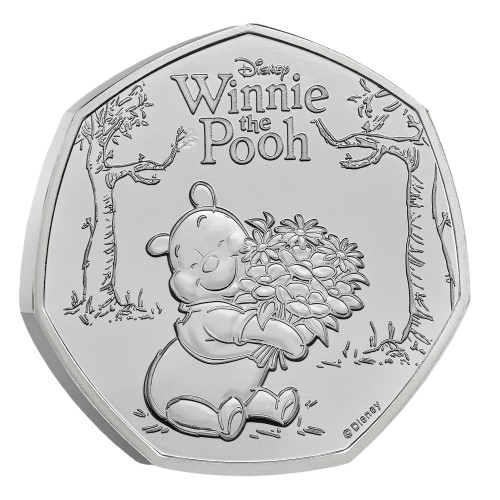
Winnie The Pooh 2026 Kindness 50p Coin
|
2026 | — | — | £15.00 | View |