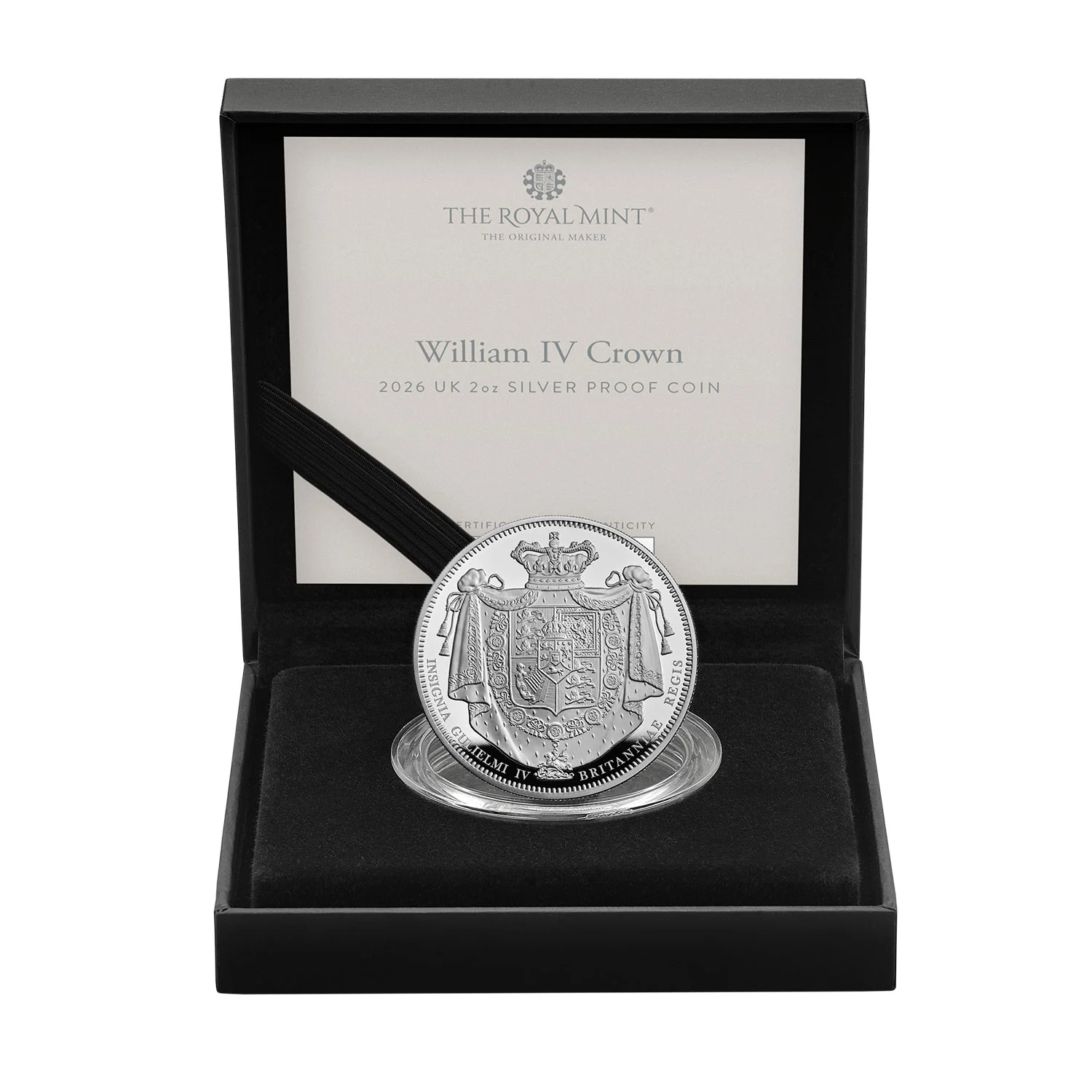
William IV Crown 2026 UK 2oz Silver Proof Coin
The Great Engravers Collection • Merlen shield reverse • 2oz .999 silver proof
Quick facts (at-a-glance)
- Series
- The Great Engravers Collection (2026 release focused on Merlen)
- Coin
- William IV Crown 2026 UK 2oz Silver Proof
- Denomination
- £5
- Metal / purity
- Silver, .999 fine
- Weight
- 62.86 g (2oz class)
- Diameter
- 40.00 mm
- Finish
- Proof
- Edge
- Milled
- Reverse designer
- Jean Baptiste Merlen
- Obverse designer
- Martin Jennings
- Year
- 2026
- Maximum mintage
- 3,110
- Royal Mint listing
- Limited Edition product page context
Specifications
| Attribute | Value |
|---|---|
| Denomination | £5 |
| Metal / purity | Silver, .999 fine |
| Weight | 62.86 g (2oz class) |
| Diameter | 40.00 mm |
| Finish | Proof |
| Edge | Milled |
| Reverse designer | Jean Baptiste Merlen |
| Obverse designer | Martin Jennings |
| Maximum coin mintage | 3,110 |
Full numismatic review
The Great Engravers Collection is, at its core, a controlled exercise in time travel: the Royal Mint selects an historic “showstopper” design, remasters it with modern production tools, and then strikes it in precious metal at proof standard—usually at sizes that give the engraving room to breathe. The William IV Crown 2026 UK 2oz Silver Proof Coin continues that tradition by spotlighting a name that belongs in any serious conversation about nineteenth-century British coin artistry: Jean Baptiste Merlen.
For collectors, this release hits a satisfying intersection: it’s a coin that is (1) visibly complex and therefore “proof-friendly,” (2) historically anchored in an original crown design that is admired and sought after, and (3) part of a modern series that has trained the market to pay attention. Even if you approach Great Engravers with a raised eyebrow—because modern proofs can sometimes feel like museum gift-shop merch with a denomination—this one makes a strong case on pure numismatic aesthetics.
The historical hook: an iconic crown reverse, revived
The Royal Mint frames this William IV issue as a celebration of Merlen’s intricate shield design from the historic William IV crown, emphasizing both the artistry and the fidelity of the modern remastering. The range overview presents it as a heraldic masterpiece—multiple shields, garter symbolism, and the royal mantle—and notes that the modern rendition was created using scans from an original William IV crown to bring new clarity while echoing traditional hand-engraving methods.
That last part matters more than marketing fluff. When you remaster an old design, the “sin” is sanding off the original character—over-cleaning it until it looks like generic vector art. If the Mint is genuinely working from scans of an original piece, the goal becomes preservation rather than reinterpretation: keep the micro-decisions the engraver made (line weight, spacing, texture, depth cues), but present them with modern die-making precision. For a reverse this busy, that approach can be the difference between “numismatic art” and “pretty pattern.”
Design read: why Merlen’s shield works so well on a modern proof
Heraldic reverses live or die by structure. They can be astonishingly detailed and still feel flat if the eye doesn’t know where to rest. Merlen’s composition solves this by using hierarchy: the shields and garter elements establish the core geometry, while the mantle frames the scene with ceremonial drama. The Royal Mint highlights the four shields encircled by the collar of the Order of the Garter and framed by the royal mantle—symbolism and artistry welded together in one dense, readable composition.
Proof striking is basically stage lighting for relief. On a successful proof coin, mirrored fields and frosted devices create contrast that makes depth legible at a glance. A mantle-and-shields reverse is tailor-made for that: fabric textures, layered folds, crisp linework around the arms and garter, and the interplay of bright field and matte detail can look almost architectural. On the 2oz format—62.86 g, 40.00 mm—there’s enough surface area for the proof finish to do its job without the design feeling cramped.
Collectors who love this style often talk about “resolution”—not in a digital sense, but in the sense that fine details separate cleanly rather than turning into shimmer. The remastering intent (clarity and precision, echoing hand engraving) suggests that “resolution” is exactly what this release is aiming to deliver.
Obverse context: modern monarch portrait, historic reverse
The obverse is credited to Martin Jennings on the Royal Mint specification for this coin. In the Great Engravers formula, the obverse usually plays the role of “official anchor” while the reverse carries the artistic fireworks. That pairing—current coinage portrait with historic reverse—creates a deliberate tension: the coin is simultaneously modern legal tender (in form) and historic tribute (in spirit).
From a collecting standpoint, that duality is a feature, not a bug. It’s what makes the Great Engravers series feel like a curated gallery rather than a pure reproduction program. You’re not buying a counterfeit “1831 crown”; you’re buying a 2026 collector strike that openly declares itself as modern while borrowing the best parts of the past.
Specs that matter (and what they imply for collectors)
The core specifications are straightforward: £5 denomination, .999 fine silver, 62.86 g, 40.00 mm, proof quality, milled edge, and a maximum coin mintage of 3,110. What’s interesting isn’t the metal (2oz proofs are common enough); it’s the positioning inside the Great Engravers ecosystem.
Great Engravers buyers tend to split into two overlapping tribes: design-driven collectors chasing a coherent “museum shelf” of iconic British motifs, and series-driven completists who treat each release as a chapter in a long-running saga. The William IV Crown is positioned as Merlen’s first appearance in the series, which matters because it expands the “cast” beyond the names collectors have come to expect.
Mintage is the other lever. A maximum mintage of 3,110 sounds generous until you remember the series’ global audience, the “display case” nature of proofs (many never return to market quickly), and the fact that the Mint also offers larger and gold formats that siphon away some demand but also amplify publicity for the design.
Other coins in the William IV Crown range (from your attached JSON)
- William IV Crown 2026 UK 5oz Silver Proof Coin — larger silver format for maximum design impact.
- William IV Crown 2026 UK 10oz Silver Proof Coin — the statement-piece silver format.
- William IV Crown 2026 UK 2oz Gold Proof Coin — the “same footprint, different metal” prestige option.
- William IV Crown 2026 UK 5oz Gold Proof Coin — heavyweight gold showpiece.
- The Merlen Shield Silver Two-Coin Set — pairs the 2026 2oz silver proof with an 1834 Halfcrown.
- The Merlen Shield Gold Four-Coin Set — pairs the 2026 2oz gold proof with historic Sovereigns across multiple reigns.
The range is built like a set of collector “ladders”: size (2oz → 5oz → 10oz), metal (silver → gold), and history (standalone modern proof → curated sets with original circulating pieces). That last ladder is especially persuasive for collectors who want context you can hold, not just a modern proof in a box.
FAQ
What is the denomination of the William IV Crown 2026 2oz Silver Proof?
It is denominated at £5 on the Royal Mint specification.
How much silver is in the coin?
The coin is listed as .999 fine silver with a weight of 62.86 g.
What is the maximum mintage?
The maximum coin mintage is listed as 3,110 for the 2oz silver proof.
Who designed the reverse?
The reverse is credited to Jean Baptiste Merlen.
What other formats exist in the William IV Crown range?
Your attached JSON includes additional sizes and metals (including 5oz and 10oz silver proofs, and gold proof editions), plus curated sets pairing the modern coin with historic halfcrowns and sovereigns.
Final verdict
The William IV Crown 2026 UK 2oz Silver Proof succeeds because it’s built around a reverse design that can actually carry a premium proof format without feeling like mere decoration. Merlen’s heraldic composition is dense but organized, ceremonial but readable, and perfectly suited to modern remastering—especially with the Mint’s emphasis on authenticity and clarity.
If you want the “core” William IV Crown experience in the most balanced format—large enough to showcase the engraving, manageable enough to store and display—the 2oz silver proof is the sensible center of the range. The bigger sizes and gold versions are temptations for specialists; the two-coin and four-coin sets are catnip for history-forward collectors.