King James Bible £2 Coin (2011): Collector Guide
The 2011 King James Bible £2 coin is a modern UK commemorative that feels unusually “bookish” for a piece of pocket change.
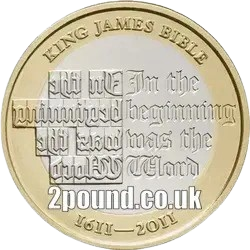
It marks the 400th anniversary of the King James Bible (first published in 1611) and uses typography as the main visual language,
turning a £2 coin into something that looks like a tiny printed page.
It is also a true change-hunt coin: the circulating mintage is low enough that many collectors still remember the first time they spotted one.
If you collect UK £2 coins in circulation, this is one of the key 2011 designs to tick off.
Quick facts
| Denomination |
£2 (Two Pounds), bimetallic |
| Year |
2011 |
| Theme |
400th Anniversary of the King James Bible (1611 to 2011) |
| Reverse designers |
Paul Stafford and Benjamin Wright |
| Obverse portrait |
Queen Elizabeth II (Ian Rank-Broadley) |
| Edge inscription |
THE AUTHORISED VERSION |
| Circulating mintage |
975,000 |
| Standard £2 specs |
28.4mm, 12.0g, 2.50mm thick |
Why this £2 coin matters to collectors
Some commemoratives are popular because they look dramatic. Others are popular because they are hard to find.
The King James Bible £2 coin is a bit of both. The design is distinctive, instantly recognisable once you know it,
and the mintage is low enough to create real demand among collectors building complete £2 runs.
The big reason it stays on “wanted lists” is simple: it was struck for circulation, but not in huge numbers.
That creates the kind of slow-burn scarcity that makes a coin feel special without requiring it to be centuries old.
There is also a set-building effect at play. Many collectors target the key circulating £2 commemoratives year-by-year.
Since 2011 has multiple notable designs, finding this one becomes part of a satisfying mini-quest.
The story behind the coin
First published in 1611, the King James Bible (also known as the “Authorised Version”) became one of the most influential books
in the English language, shaping religious practice, literature, idioms, and everyday phrases for centuries.
By 2011, it was not only a religious milestone but also a cultural one, a reminder of how printing and translation can ripple outward into society.
The Royal Mint’s approach here is clever: instead of depicting a king, a cathedral, or a portrait of a famous figure,
the coin celebrates the text itself. It honours the thing that actually endured: the words on the page.
Design details: how to identify it quickly
Reverse (tails): “In the beginning was the Word”
The reverse takes inspiration from the opening of the Gospel of John, presented as if you are looking at a piece of printed material.
The design is arranged like a page layout, with bold typographic blocks that resemble headings or typeset lines.
It is one of the most text-forward £2 designs in modern UK circulation.
Identification tip: if the coin looks like a printed page at arm’s length, you are probably holding the King James Bible design.
Many other £2 commemoratives use pictorial elements (buildings, portraits, objects). This one leans hard into typography.
You will also see the anniversary dates 1611 and 2011 worked into the layout, tying the design to the 400-year theme.
Obverse (heads): Elizabeth II, Rank-Broadley portrait
The obverse uses the Ian Rank-Broadley effigy of Queen Elizabeth II, a familiar portrait for collectors of UK decimal coinage.
On circulated examples, the highest points of the portrait and the rim can show flattening or small knocks first.
That is normal wear, and it does not mean a coin is “damaged” in a collecting sense.
Edge inscription: the easiest confirmation
The edge inscription is one of the cleanest ways to confirm you have the right coin:
THE AUTHORISED VERSION.
It is short, direct, and thematically perfect. If you are sorting a pile of £2 coins quickly, checking the edge text can save time.
Specifications and metal composition
Like standard modern £2 coins, the King James Bible issue is bimetallic with a gold-coloured outer ring and a silver-coloured inner disc.
The colour contrast makes the design readable even when a coin is well circulated, and it helps the £2 stand out in the hand.
- Diameter: 28.4mm
- Weight: 12.0g
- Thickness: 2.50mm
- Construction: bimetallic outer ring and inner disc
- Edge: milled with incuse lettering
If you are checking authenticity, the most practical approach is comparison.
Put it next to another known genuine £2 coin and look for the same overall thickness, the same “snap” of the bimetallic join,
and crisp, consistent lettering on both sides.
Mintage and rarity: why it feels hard to find
The circulating mintage is 975,000. In £2 collecting terms, that is a genuinely low number.
It is not “impossible”, but it is far from common. Many people can go years without seeing one in daily change,
especially as cash use declines and fewer coins move through tills.
Scarcity alone does not create a collecting classic, but scarcity plus a distinctive design often does.
This coin has both, and that is why it remains one of the better-known modern £2 commemoratives.
Another factor: because the reverse is text-heavy, wear can reduce the sharpness of the typography faster than it reduces a bold pictorial design.
That means higher-grade examples can feel noticeably nicer than “average circulated” ones, which helps create a premium for cleaner coins.
What it is typically worth
The value of a circulating commemorative is mostly driven by three things: mintage, demand, and condition.
The King James Bible £2 coin scores well on the first two, and condition is the lever that makes the price move.
In everyday circulated condition, it usually sells for a clear premium over face value.
Cleaner circulated coins and Brilliant Uncirculated examples generally command more, especially if they have fewer marks in the fields and sharper text detail.
Market prices shift, so treat any single number you see online as a snapshot rather than a rule.
Practical collector move: if you are building a display-quality £2 collection, it is often worth paying a bit extra for a noticeably cleaner example,
because the design reads much better when the typography is crisp.
Condition tips for a text-based design
With many commemoratives, the main wear points are faces, buildings, or large shapes.
Here, the “detail” is the typography and the fine texture that makes the design look printed.
That changes what you should look for:
Signs of a stronger example
- Letters are sharp and legible without needing to tilt the coin to the light.
- Fields (flat areas) are relatively clean with fewer deep scratches.
- Minimal edge knocks, especially near the lettering.
- Good contrast between the outer ring and inner disc with no harsh discolouration.
Common circulation marks that are normal
- Small scuffs on the inner disc from coin-to-coin contact.
- Light rim nicks from vending machines and coin bags.
- General dulling of lustre from handling.
Do not clean it
Cleaning is the fastest way to reduce collector appeal. It leaves hairline scratches and an unnatural shine,
and on a design like this, cleaning can make the fields look smeared or cloudy.
If a coin is grimy, store it properly and let time do less damage than a cloth and good intentions.
Errors and myths: what to ignore
Modern coins attract a lot of viral “rare error” claims. Most are noise. For this coin, here are the common misunderstandings:
Normal and not automatically valuable
- Edge text orientation: the direction the inscription reads can vary.
- Minor alignment differences: small rotation can happen within tolerances and wear.
- Small marks and toning: typical for circulated bimetallic £2 coins.
What can be worth a closer look
- Major off-centre strike: clearly shifted design with missing rim detail.
- Significant missing or distorted lettering: beyond normal wear.
- Unusual planchet defects: obvious metal flaws present from the start.
Real errors tend to be obvious in good photos and consistent across multiple parts of the coin.
If you need a ten-paragraph explanation and three red circles to prove it is “rare”, it usually is not.
How to find one in the wild
Because cash moves less than it used to, the best strategy is consistency rather than luck.
You want more coin exposure per week, not one heroic search session per month.
Simple change-hunting routine
- Always check £2 coins: flip them and scan reverses first.
- Learn the silhouette: “printed page” look is a fast spot.
- Keep a swap pile: duplicates can be traded or used to fund upgrades.
- Use mixed sources: supermarkets, parking, transport, and any cash-heavy environments.
If you handle a lot of cash, it becomes much more likely you will find this coin naturally.
If you do not, buying a clean example for the collection can be the most time-efficient route.
Collector notes: why this coin has staying power
The King James Bible £2 coin is a nice reminder that “commemorative” does not have to mean statues and portraits.
It is abstract, typographic, and confident. That makes it stand out in albums and in memory.
It also sits in a sweet spot for modern collecting: scarce enough to feel like a win when you find it,
but available enough that completing the goal is realistic.
That balance is what turns casual change-checkers into proper collectors.
FAQ
What does the edge inscription say?
THE AUTHORISED VERSION.
Is the 2011 King James Bible £2 coin rare?
It is considered scarce for a circulating £2 coin because the mintage is under one million.
That usually translates to a noticeable premium over face value and fewer sightings in everyday change.
Is it a circulation coin or a collector-only release?
It was issued as a circulating commemorative £2 design, meaning it was intended for general use.
Cleaner examples exist, but most found in the wild show normal wear.
Should I clean it?
No. Store it safely and keep it as-found.