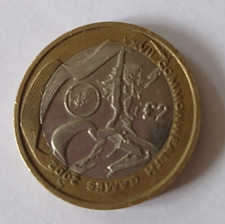
Commonwealth Games – Wales £2 Coin (2002): A Coin Collector’s Guide
The 2002 Commonwealth Games – Wales £2 coin is one of those modern UK circulation pieces that feels
like it should be common, right up until you actually go hunting for it. It was issued for the XVII Commonwealth Games held in Manchester in 2002, and it's part of a four-coin set celebrating the UK's home nations with near-identical designs that swap out the flag cameo.
In collector terms, the Wales version is famous for two things:
- (1) it's genuinely scarce in circulation with a circulating mintage of 588,500
- (2) it's an essential “set-completer” coin because many collectors chase all four home-nation designs.
Quick Identification Checklist
- Denomination: £2 (bimetallic: gold-coloured outer ring, silver-coloured centre)
- Date: 2002
-
Reverse design: an athlete in motion with a flowing banner; a circular cameo contains the
Welsh flag
-
Edge inscription: "SPIRIT OF FRIENDSHIP, MANCHESTER 2002"
If your £2 coin is dated 2002 but has the standard “Technology” reverse (the older abstract/mechanical design),
you've got a different 2002 £2. The Commonwealth Games designs are very easy to spot once you know to look for the athlete
and the flag cameo.
Why This Coin Exists: Manchester 2002 and the “Home Nations” Set
The 2002 Commonwealth Games were a big deal for the UK: a major international multi-sport event hosted in Manchester,
and—crucially for coin collectors, a perfect excuse to create a highly "collectable-by-design" set. The Royal Mint issued
four near-matching £2 coins representing England, Scotland, Wales, and Northern Ireland.
The clever part is psychological: once people learn there are four, many of them stop being "casual" collectors and
become "set hunters". Set hunting is basically the coin-collector equivalent of Pokémon. One becomes four. Four becomes
a folder. A folder becomes "I should probably start grading these". The hobby escalates quickly!
Design and Symbolism (Reverse, Obverse, Legends, Edge)
Reverse (tails side): athlete + banner + Welsh flag cameo
The reverse shows a dynamic athlete breaking through at the finish (often described as "runner breaking ribbon"), paired with a sweeping banner that echoes sporting lanes and motion. Behind the athlete is a circular cameo featuring the flag of Wales, which is what separates this coin from the England/Scotland/Northern Ireland versions.
Conceptually, it's a nice bit of design efficiency: one core artwork that can be "re-skinned" into four collectable variants.
The banner/lanes motif also plays well with multiple sports rather than locking the coin to a single event (like a football or
a specific stadium).
Designer
The reverse design is credited to Matthew Bonaccorsi.
Obverse (heads side): Queen Elizabeth II portrait
The obverse carries the definitive portrait of Queen Elizabeth II used on circulating coinage at the time,
designed by Ian Rank-Broadley.
For collectors, obverses matter because portrait changes can help you date coins at a glance—and because certain errors/varieties
show up on the obverse (mis-strikes, die clashes, odd lettering, and so on). For this specific coin, the obverse is typically the "stable" part; the reverse is where the identity lives.
Edge inscription: the phrase collectors actually check
The edge inscription is widely recorded as:
SPIRIT OF FRIENDSHIP, MANCHESTER 2002.
In practice, collectors use edge lettering as a fast authenticity/diagnostic check—especially when photos online are blurry or when a coin has heavy circulation wear on the faces.
Official-Style Specifications
Modern UK £2 coins are engineered objects as much as they are miniature sculptures: bimetallic construction, tight tolerances,
and a standard size that makes them easy to validate (by machines and by collectors).
| Spec |
Commonwealth Games – Wales £2 (2002) |
| Composition |
Bimetallic (outer ring + inner centre) |
| Weight |
12.0 g (often listed around 12 g / ~12.08 g depending on cataloguing)} |
| Diameter |
28.4 mm (catalogued around 28–28.4 mm) |
| Year |
2002 |
| Mint |
The Royal Mint (Llantrisant) |
Collector tip: because the weight and diameter are so standardized, a cheap digital scale and calipers are surprisingly useful tools for screening suspicious coins, especially if you buy online.
Mintage, Rarity, and What "Scarce in Circulation" Really Means
The headline number, because collectors love numbers, is the circulating mintage:
588,500.
The Royal Mint has also highlighted this coin as one of the rarest UK £2 coins, placing it second on its scarcity list. It’s especially notable because it's rare without being ancient. You don’t need Roman archaeology to enjoy this one; you just need patience, good change habits, and maybe a mild UK coin collecting obsession.
How it stacks up inside the Commonwealth Games set
In the four-coin Commonwealth Games series, Wales is described as the second rarest of the set, with Northern Ireland being rarer still. That matters because set-completers often chase the scarcest coin last, and “the last one” tends to attract a premium.
Rarity vs. availability: the survival-rate problem
A mintage figure is the start of the story, not the end. Coins get lost, exported, hoarded, damaged, and sometimes just vanish into collections and never return to circulation. That means two coins with the same mintage can feel very different in real-world hunting.
The Wales Commonwealth Games £2 has the added collector gravity of being part of a mini-set, which increases how many of them are pulled from change jars and tucked away.
How to Find the Wales Commonwealth Games £2 in Circulation
This coin was released into circulation as a circulating commemorative hence in theory, you can still find it in everyday change. In practice, you’re more likely to encounter it through:
- High-cash environments: cafés, charity shops, small retailers, events, and anywhere coins still move quickly.
- Coin-heavy routines: parking meters, self-serve car washes, vending machines (where coin use still exists).
- Family "change consolidation": offering to swap coins for notes when relatives empty jars.
Collector reality check: because the mintage is low, a quick hunt for this coin can easily turn into a long-term side quest. That's not failure, that's the hobby.
Condition, Wear Patterns, and Grading Notes
With bimetallic £2 coins, condition is often about contrast: you want the outer ring and inner core to look clean,
the design to have crisp detail, and the fields (flat areas) to avoid deep bag marks or scratches.
Common circulation wear you’ll see
- High-point smoothing: the athlete's raised detail and the banner edges lose sharpness first.
- Contact marks: especially in the fields around the design from coin-on-coin contact.
- Edge knocks: bimetallic edges take hits easily, which can distract from an otherwise decent coin.
- Toning / discolouration: the ring and centre can tone differently; some collectors like this, others don't.
Third-party grading (NGC/PCGS): when it makes sense
Grading can make sense if you have a truly high-end example (near-gem uncirculated, exceptional surfaces, strong strike),
or if you’re building a registry-style collection. NGC catalogues the type and lists the designers and specs for the 2002 Wales reverse.
For most collectors, though, the Wales £2 is a “smart raw coin” in a capsule or album: scarce, iconic, and satisfying to own without needing plastic.
Value, Premiums, and What Actually Drives the Price
Coin values move with condition, demand, and timing. Instead of pretending there’s one “correct” number, think in layers:
base scarcity (low mintage) + set demand (people want all four) + condition premium
(uncirculated always commands more) + selling format (dealer retail vs. auction vs. private sale).
Examples of the market (for context, not a guarantee)
-
A UK dealer listing for a circulated 2002 Wales Commonwealth Games £2 has been advertised from around £18.
Those are snapshots from specific sellers and moments in time, not a universal price. Your coin’s real-world value depends heavily on condition and on how you sell it. The same design can sell for dramatically different amounts when it's certified at a high grade versus heavily circulated.
What tends to add a premium
- Uncirculated surfaces: fewer marks, stronger luster, and sharp detail.
- Strong eye appeal: clean ring to centre contrast, attractive toning (if present), minimal edge knocks.
- Being part of a set: complete four-coin Commonwealth Games groups usually sell more easily than singles.
- Verified authenticity: reputable dealer, clear photos, or third-party grading.
Errors, Varieties, and Misleading Claims to Watch For
Modern UK coin collecting has a weird ecosystem of exaggerated listings and "RARE!!" headlines. The Wales Commonwealth Games £2 is legitimately scarce, so it gets dragged into hype culture fairly often.
Edge inscription confusion
The standard edge inscription is documented as "SPIRIT OF FRIENDSHIP, MANCHESTER 2002". If a listing claims a different edge inscription makes it ultra-rare, treat that as "prove it with clear photos and credible attribution", not as fact.
Common “not really an error” situations
- Die rotation: slight rotation is fairly common; large rotation is more interesting but still niche.
- Minor mis-strikes: off-centre strikes exist but must be obvious and verifiable to carry value.
- Post-mint damage: scratches, dents, and signs someone attacked it with a tool are damage, not treasure.
Best practice: if someone claims "one-of-a-kind error", ask for (or look for) evidence that a grading service or recognized specialist has attributed it. Otherwise, it’s probably just a coin having a rough day in circulation.
Buying, Selling, and Storing the Coin Like a Sensible Wizard
Buying tips
- Prioritize clear photos: you want both sides and the edge inscription if possible.
- Check the right reverse: athlete + banner + Welsh flag cameo.
- Watch for “too perfect, too cheap” deals: modern coins can be counterfeited, especially popular scarce types.
- Buy the coin, not the story: a dramatic listing description doesn’t improve the metal.
Selling tips
- Describe condition honestly: collectors can spot “uncirculated” claims from a mile away.
- Photograph the edge: the inscription is a key identifier.
- Consider selling as a set: if you have all four Commonwealth Games £2 coins, that can increase buyer interest.
Storage
For long-term keeping, use inert materials: coin capsules, album pages designed for £2 coins, or non-PVC flips.
Avoid adhesives, tape, or soft plastics that can leach chemicals and haze the surfaces over time.
Also: don’t clean it. Cleaning is the fastest way to turn “scarce collectable” into “scarce coin with suspicious hairlines.”
Collector Strategies: How People Actually Collect This Coin
The Wales 2002 Commonwealth Games £2 works nicely in multiple collecting styles:
- Circulation finds: the pure joy route—harder, slower, and weirdly more satisfying.
- Type set: one example of each major £2 commemorative theme/era.
- Event set: sports-related UK coins (Commonwealth, Olympics, athletics-themed issues).
- Home nations mini-set: all four Commonwealth Games designs.
- Condition ladder: upgrading over time (Fine → Very Fine → Extremely Fine → Uncirculated).
The “mini-set” approach is especially popular because it’s finite, visually coherent, and has a built-in climax: finding the scarcest ones to finish the set.
FAQs
Is the Commonwealth Games – Wales £2 coin still legal tender?
Yes—this is a standard £2 circulating commemorative coin type.
Why is it considered rare?
Because the circulating mintage is low at 588,500, and it’s heavily collected as part of the four-coin set.
How do I confirm it’s the Wales version?
Look for the Welsh flag cameo on the reverse behind the athlete, and check the edge inscription wording.
Who designed it?
Reverse: Matthew Bonaccorsi. Obverse portrait: Ian Rank-Broadley.
Sources (Collector-Friendly)
- The Royal Mint – Rarest UK £2 coins (includes Wales 2002 mintage and series context)
- NGC World Coin Price Guide – Great Britain 2 Pounds (type info, designers, specs, reverse description)


![2002 Commonwealth Games £2 Coin [England/Wales/etc] – Rare Circulated - Available on eBay](https://i.ebayimg.com/images/g/KCAAAeSwiSJp0kSr/s-l225.jpg "2002 Commonwealth Games £2 Coin [England/Wales/etc] – Rare Circulated")