Britannia (Fifth Portrait) £2 Coin: the “ordinary” £2 that is oddly hard to find
The 2015 Britannia £2 looks like it should be common. It is not. This is the first year the standard, non commemorative
£2 design switched away from the old “Technology” reverse that ran for years. Instead, the coin brings Britannia back
to the £2 in a bold, modern style. Pair that with Queen Elizabeth II’s fifth definitive portrait on the obverse and you
get a coin that feels like a quiet reset for UK coinage.
In circulation, this coin has built a reputation as a proper “change find” trophy. It is not rare in the mythic sense
of one known example locked in a vault, but it is scarce enough that many collectors go years before they spot one in
the wild. The reason is simple: the circulation mintage is low by £2 standards, so fewer coins were available to
bounce around tills, buses, self checkouts, and coin jars.
Key specifications collectors care about
The UK £2 format is one of the easiest coins to learn because it is consistent: bicolour, chunky, and designed to be
instantly recognisable by touch as well as sight. For the Britannia (fifth portrait) issue, the headline details are
the date, the low mintage, and the pairing of designers.
- Year: 2015
- Circulation mintage: 650,000
- Denomination: £2
- Diameter: 28.4 mm
- Weight: 12.0 g
- Obverse designer: Jody Clark (fifth portrait of Queen Elizabeth II)
- Reverse designer: Antony Dufort (Britannia)
- Edge inscription (standard Britannia design): QUATUOR MARIA VINDICO
If you only remember one thing: a 2015 £2 with Britannia on the reverse and the fifth portrait on the obverse is the
key combination. Everything else is supporting detail.
The reverse: Britannia, recast for a modern £2
Britannia has been used as a national personification for centuries, but she is not a museum piece on this coin. Antony
Dufort’s design gives her a sharper, more contemporary presence. She stands helmeted, shield forward, trident angled,
with a stance that reads as defensive and determined rather than decorative.
On a practical level, the reverse works well at pocket distance: the main shapes are bold, the silhouette is clear, and
the composition holds up even when the coin is worn. On a collector level, it marks a significant switch. The long
running “Technology” design that many people still associate with the £2 was replaced, and Britannia became the new
standard look for the denomination.
The small details are worth slowing down for. Look at the way the helmet sits, the curve of the shield, and how the
trident points. In higher grades, the surfaces show crisp relief and a satisfying contrast between the gold coloured
outer ring and silver coloured inner disc. In heavily circulated condition, the high points flatten first, so the face,
helmet and shield edges are usually the first places to show smoothing.
The obverse: the fifth definitive portrait of Queen Elizabeth II
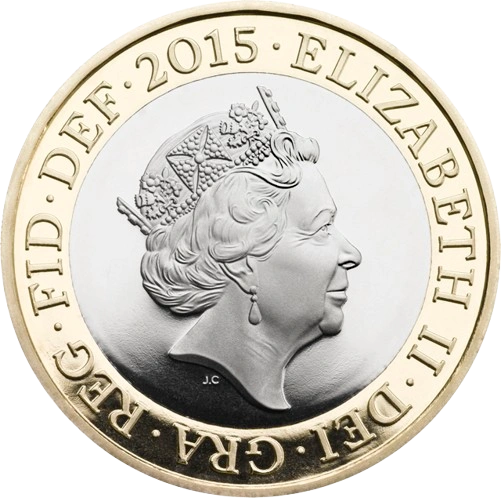
The “fifth portrait” label matters because it instantly dates the era. Jody Clark’s effigy was introduced for UK coins
in 2015 and it has a cleaner, more contemporary feel than earlier portraits. On the £2 format, it tends to look
especially strong because the coin is large enough to show the hair detail and facial modelling clearly.
When you are checking a 2015 Britannia £2 in hand, the obverse helps you confirm you have the right variety. Some £2
designs share the same year and portrait, so think of it as a two factor check: (1) fifth portrait on the front, (2)
Britannia on the back. If both match, you are in the correct lane.
The edge inscription: what it says, what it means, and why people miss it
The standard Britannia £2 edge inscription is QUATUOR MARIA VINDICO, a Latin phrase commonly given as
“I will claim the four seas”. It is a classic Britannia motto and fits the maritime symbolism of the trident and shield.
The lettering is incuse, meaning it is sunk into the edge rather than raised, and on a worn coin it can be faint unless
the light hits it at the right angle.
A quick tip: rotate the coin slowly under a lamp and let the edge lettering catch the light. On coins that have been in
pockets for years, grime can settle into the letters and actually make them easier to read. On bright, cleaned coins
(not recommended), the lettering can look oddly flat.
Another tip: do not panic if you cannot read the entire inscription. Partial letters are normal. What matters is that
the edge has crisp milling and consistent lettering, not a mushy, uneven edge. A badly formed edge can be a sign of
heavy wear, damage, or in rare cases, something that deserves a closer look.
Why the 2015 Britannia £2 is scarce in circulation
The rarity story here is not about a secret one day release or a mythical error. It is about numbers. The 2015 Britannia
£2 has a circulation mintage of 650,000, which is low for a denomination that usually appears in the millions. Fewer
coins minted means fewer coins to be distributed, fewer coins to be spent, and fewer coins to be found by collectors
hunting through everyday change.
There is also a psychological factor: because this is a “standard design” coin, people do not treat it like a
commemorative. A lot of collectors only started paying attention after hearing it was a tough one to find, so demand
grew from word of mouth and collector checklists rather than public hype.
Put those together and you get the perfect modern circulation rarity: a normal looking £2 that hides in plain sight,
and then refuses to appear when you go looking for it.
How to identify it quickly in your change
If you are scanning a handful of £2 coins, you want a fast process that catches the rare ones without slowing you down.
Start with the date. If you see 2015, flip it. If the reverse shows Britannia, you are very likely holding the coin you
want.
If you are checking a lot of coins at once, use the reverse as the primary filter. The Britannia design has a distinctive
figure and large areas of open field compared to many commemoratives. Once you spot the Britannia silhouette, then check
the date and, if you like, confirm the edge inscription.
Places these show up (when they decide to grace us with their presence): mixed bank bags, charity shop tills, old change
jars, and busy retail environments where coins circulate quickly. They are less likely to be found in small, quiet loops
where the same coins keep returning to the same place.
Value guide: what collectors typically pay and why prices vary
In circulated condition, the 2015 Britannia (fifth portrait) £2 often trades around the low single digits above face
value, with many collector guides clustering around roughly £4 for a typical circulated example.
Better condition examples, especially those with minimal edge knocks and cleaner fields, can move higher.
Brilliant Uncirculated examples (often taken from official packs or sets) usually command a stronger premium because
they preserve the sharp detail on Britannia’s helmet, the shield edges, and the obverse portrait. A common ballpark
figure you will see in collector guides is around £12 for a BU example, with the usual caveat that
real world prices move with demand, condition, and where the coin is sold.
Three factors tend to matter most:
- Condition: fewer marks, cleaner fields, stronger edge lettering, and less colour dulling.
- Presentation: loose coin versus a coin in an official style pack or set.
- Timing: collector demand rises and falls, so check recent completed sales rather than active listings.
A gentle warning from experience: the internet is full of optimistic asking prices. Completed sales and dealer buy
prices are usually closer to reality than listings that have been relisted for months.
Condition checklist for a circulation find
Most 2015 Britannia £2 coins found in change will be circulated. That is normal. The goal is not perfection; the goal is
to decide whether the coin is a nice example worth keeping as your main slot filler, or a heavily worn placeholder you
might upgrade later.
Here is what to look for when you tilt the coin under light:
- Britannia’s helmet and face: sharp detail here usually signals lighter wear.
- Shield lines: flattened edges suggest heavy circulation.
- Fields: watch for scratches that cut across open areas on the reverse.
- Rim and edge: knocks and dents matter because they are hard to ignore in a display tray.
- Colour: an even tone is nicer than patchy staining, although age toning can be attractive.
If you are building a tidy set, the best strategy is often to keep the first one you find, then quietly upgrade when a
sharper example turns up. That way you keep progress moving without getting stuck waiting for the “perfect” coin.
Common mix ups: Britannia vs other 2015 coins with similar vibes
2015 is a busy year for £2 collectors, and it is easy to mix designs if you are new to the denomination. One particular
confusion is the edge inscription THE SURE SHIELD OF BRITAIN. That inscription is associated with a
different 2015 £2 design (the First World War Royal Navy coin), not the standard Britannia reverse.
So here is the simple rule: if the reverse is Britannia, you should normally expect the Latin edge inscription
QUATUOR MARIA VINDICO. If the reverse shows a warship scene and First World War theming, then THE SURE SHIELD OF BRITAIN
is exactly what you should see on the edge.
This matters because both coins are scarce and both can show up as 2015 change finds. The good news is that either one
is worth a second look. The better news is that this little confusion is how many collectors accidentally start a 2015
mini set.
Errors, oddities, and what is actually worth checking
Modern UK coins can show minor production variations, but most “errors” people talk about online are either normal wear
or misunderstandings. For the 2015 Britannia £2, the checks that make sense are practical ones:
- Edge lettering quality: missing letters can happen from wear, but a completely absent inscription is unusual.
- Alignment: very large rotation between obverse and reverse is worth noting.
- Off centre strikes: slight off centring is common; dramatic off centring is collectable.
- Metal issues: unusual plating like appearance is usually damage or contamination, not a mint rarity.
If something looks genuinely off, take clear photos in natural light and compare it to a normal example. The goal is to
rule out wear and post mint damage before you assume you have discovered a new category of treasure.
Authenticity and fakes: how to keep it sensible
£2 coins are counterfeited often enough that it is worth learning the basics, especially if you are buying coins rather
than finding them. A genuine coin should feel right in hand: correct weight, crisp rim, clean milling, and consistent
bimetal join between the outer ring and inner disc.
Quick sanity checks:
- Edge detail: fuzzy or messy lettering is a red flag, especially if the milling looks crude.
- Design sharpness: soft, blobby detail across the whole coin can signal casting.
- Ring and centre join: an odd seam or gaps can indicate a bad fake.
- Sound test: gently tapping a £2 coin can reveal differences, but do not treat this as proof on its own.
When buying online, the best protection is simple: buy from sellers with consistent feedback, insist on clear photos of
both sides and the edge, and avoid listings that hide behind blurry images or generic descriptions.
Collector strategy: how to slot it into a £2 collection
This coin fits neatly into several popular collecting routes:
- Circulation finds set: one of the tougher modern “found in change” £2 coins to tick off.
- Definitive reverse history: a key transition point away from the Technology era.
- Portrait timeline set: the beginning of the fifth portrait era on the £2 denomination.
- Britannia theme set: a modern Britannia to sit alongside earlier Britannia coins in other denominations.
The nice thing is that you do not need to overcomplicate it. One decent circulated example is enough to make the set feel
complete. If you love the design, chasing a cleaner example is a fun upgrade goal that does not require a mortgage.
Storage and display: keeping it nice without going full museum
For a circulated Britannia £2, the best approach is protective but simple. A basic 2x2 coin holder, a capsule sized for
UK £2 coins, or a good album page will keep the rims from getting knocked and the surfaces from collecting new scratches.
If you store coins loose in a tin, they will continue to tone and mark each other. That is fine for pocket change, not
ideal for a collection.
Avoid harsh cleaning. Cleaning does not restore value; it usually removes it. Collectors prefer original surfaces, even
when those surfaces show honest circulation wear. A coin that looks “too shiny” often looks wrong for its age, and it is
hard to reverse that.
Quick FAQs
Is the 2015 Britannia £2 a commemorative coin?
No. It is a standard design issue for the £2 denomination, introduced as the regular reverse design from 2015, featuring
Britannia.
Why do people call it rare if it is a standard design?
Because the circulation mintage for the 2015 issue is low compared to typical £2 outputs, making it much less common in
everyday change than most dates.
What should the edge inscription be?
For the standard Britannia £2 design, the edge inscription is QUATUOR MARIA VINDICO. If you see THE SURE SHIELD OF BRITAIN
you are likely looking at a different 2015 £2 design (Royal Navy themed), not Britannia.
Should I keep it if I find one in change?
If you are building a UK circulation collection, yes. Even a worn example is a solid keeper, and you can always upgrade
later.
